Things That Live Here Too: Galveston’s “Tame” Seawall Raccoons Are a Problem We Created
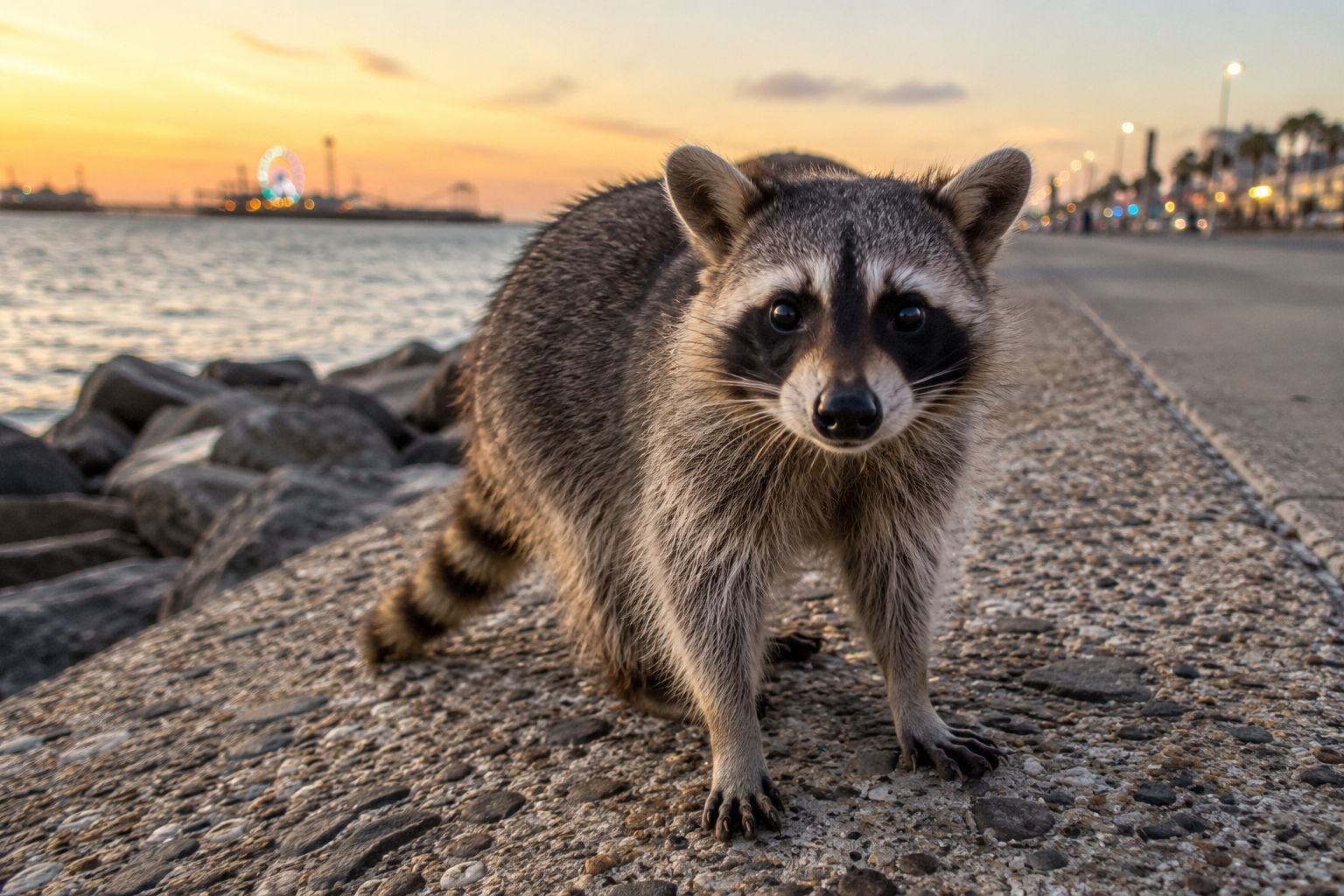
There is a stretch of Galveston where seeing a raccoon no longer requires much luck.
You may not even have to look for one.
They may come looking for you.
Along parts of the east end of the Seawall, raccoons have become remarkably comfortable around people. They walk toward visitors. They wait near places where people stop. Some appear to beg for food. Photos and videos show them gathered near the rocks with little concern about the humans standing only a few feet away.
It is easy to look at that behavior and assume Galveston somehow ended up with a population of unusually tame raccoons.
That is not what happened.
We taught them.
And now Galveston is seeing exactly why feeding wild animals is a very bad idea.
They Aren’t Tame
A tame animal has gone through a process that changes how it responds to humans.
These raccoons are still wild animals.
What has changed is their behavior.
Raccoons repeatedly given food by people learn a very simple lesson:
People equal food.
Texas Parks and Wildlife specifically warns that raccoons accustomed to being fed lose their natural fear of humans and begin moving closer to the source of that food. The City of Galveston’s own raccoon guidance gives the same warning.
That distinction matters.
A raccoon approaching a person is not becoming a pet.
It has learned that walking toward people sometimes produces dinner.
Feed that raccoon enough times and the calculation gets even easier.
Car stops.
Door opens.
Human gets out.
Food may appear.
Eventually, running away from people stops making sense to the animal.
That is what Galveston is dealing with now.
The East End Is Showing Exactly What Happens
This is not a theoretical wildlife-management problem happening somewhere else.
It is happening on Galveston Island right now.
In August 2026, Galveston officials warned residents and visitors after seven raccoon bites were reported in only two weeks near the east end of the Seawall.
Galveston Animal Services supervisor Josh Henderson told KPRC 2 that he counted 21 raccoons along that stretch during one visit. The animals approached without hesitation. Some even chewed on his boots while looking for food.
His assessment was straightforward.
They had lost their fear of people.
People have been bringing them cat food, fast food, leftovers, and other handouts.
The raccoons learned the routine.
Now they expect it.
That is the part people often miss when tossing food toward a wild animal feels like an isolated act of kindness.
The raccoon does not understand that one person intended to give it one snack on one evening.
It learns a broader lesson.
Humans provide food.
The next human may not know that lesson has already been taught.
A Raccoon Expecting Food Can Become a Raccoon Demanding Food
Imagine someone regularly handing you food every time you walked up to a particular window.
Eventually, you would probably go to the window when you were hungry.
Now imagine arriving one day and finding someone standing there who had no intention of feeding you.
The raccoon has no concept of tourists, locals, animal ordinances, wildlife etiquette, or whose McDonald’s bag belongs to whom.
It only knows that people at this location have repeatedly provided food.
That can create increasingly bold behavior.
Texas Parks and Wildlife has long warned that animals that lose their natural fear of people can become bold, aggressive, and unpredictable. That concern helped drive the prohibition against feeding wildlife in Texas state parks.
This does not mean every raccoon waiting for food will attack somebody.
It means we have removed one of the natural barriers that normally keeps encounters between people and wild animals from becoming conflicts.
A healthy wild raccoon generally has good reason to be cautious around something as large as a human.
We should want it to keep that caution.
Feeding Them Increases the Chance of Someone Getting Bitten
Raccoons have remarkably capable front feet.
They also have teeth.
When humans encourage them to come close enough to take food, those things suddenly become relevant.
A raccoon reaching for food can scratch.
A raccoon frightened while surrounded by people can bite.
A raccoon expecting food may approach somebody who does not want it nearby.
Children may try to touch one because they have watched adults feed it.
Dogs may react to one.
People may attempt to hand-feed one because another person did it five minutes earlier without getting hurt.
That is how a supposedly adorable wildlife encounter becomes an Animal Services call.
Galveston has already documented multiple bites this summer. Officials have specifically connected the problem to people feeding the animals.
Seven reported bites in two weeks should probably be enough evidence that the experiment has run its course.
Rabies Is Rare, but a Bite Still Becomes a Serious Problem
Raccoons are one of the wild mammals that can carry rabies.
That does not mean a raccoon approaching people automatically has rabies.
Food-conditioned animals can approach humans simply because humans have repeatedly rewarded that behavior.
But once a bite occurs, nobody gets to assume the animal was healthy.
Galveston officials have warned about rabies risk in connection with the recent bites. The City’s wildlife guidance also says an adult wild animal that is easily approachable or appears unusually friendly should be treated with extreme caution. People should avoid bites and contact with saliva and contact Animal Services when appropriate.
Suddenly that cute interaction can involve wound cleaning, medical evaluation, Animal Services, locating or testing an animal when possible, and decisions about rabies post-exposure treatment.
That is an impressive amount of trouble to manufacture because somebody wanted a raccoon to eat a Cheeto from their hand.
Human Food Isn’t Doing Them Any Favors Either
Feeding wildlife is often defended as helping the animal.
That argument becomes difficult to maintain when the food being offered includes fast food, processed snacks, leftovers, and piles of cat food.
Raccoons naturally eat a broad diet that can include fruits, nuts, insects, aquatic animals, fish, frogs, eggs, carrion, and other available foods.
They are extremely capable foragers.
They do not need us to teach them how to survive.
Galveston Animal Services has specifically warned that many of the foods being given to the Seawall raccoons fall far outside their normal diet. Officials have also described animals in the colony as overweight.
An overweight wild animal that has stopped relying on normal foraging is not evidence that humans have improved its life.
It is evidence that we changed it.
Feeding Also Pulls Animals Together
There is another problem with creating a dependable feeding location.
Animals gather around it.
Instead of raccoons spreading out to forage across available habitat, a regular supply of food can draw multiple animals into the same small area.
Texas Parks and Wildlife has warned that feeding wildlife can contribute to unnatural increases in animal concentrations and increase opportunities for disease transmission.
Look at the east end and the result is fairly obvious.
One raccoon learns there is food.
Others learn there is food.
People discover the raccoons.
More people arrive specifically to feed them.
The raccoons become an attraction.
More food arrives.
More animals gather.
Then everyone wonders why there are suddenly twenty raccoons waiting beside the Seawall like somebody forgot to open the restaurant.
The Problem Continues After the Person Feeding Them Leaves
The person holding the food gets the fun part.
They get the photo.
They get the video.
They get the raccoon standing nearby looking adorable.
Then they leave.
The people who remain inherit the behavior.
Nearby residents deal with animals searching for food.
Workers encounter raccoons that no longer back away.
Trash becomes another feeding source.
Visitors who never intended to interact with wildlife encounter animals that have already learned to approach them.
The City of Galveston warns homeowners that food-conditioned raccoons may move closer to houses and can become destructive once they take up residence in attics or outbuildings. The city recommends securing trash and removing accessible food sources that attract them.
This is why wildlife feeding is not merely a personal choice between one human and one raccoon.
It changes what that animal does around everybody else.
Being Afraid of People Is Good for Them
People naturally interpret trust as something positive.
With wildlife, that logic often fails.
A raccoon that runs when a person approaches is doing exactly what a wild raccoon should do.
That fear creates distance.
Distance reduces encounters.
Fewer close encounters mean fewer bites, fewer conflicts with pets, fewer complaints, and less chance that an animal eventually has to be removed because its behavior became dangerous.
Teaching wildlife not to fear us can feel like earning its trust.
What we are actually doing is removing a behavior that helps protect it.
The raccoon pays for that mistake long after the person with the bag of food has gone home.
Loving Wildlife Sometimes Means Leaving It Alone
Galveston’s raccoons are genuinely fun to see.
They are smart.
They are resourceful.
They thrive in an island environment filled with marshes, rocks, neighborhoods, fishing areas, trash cans, and endless opportunities for a clever omnivore.
Watching one work its way through the rocks along the Gulf can be one of those small things that makes living on an island interesting.
So watch it.
Take the picture.
Let your kids see it.
Then keep your food.
A wild raccoon should look at a human and understand that the human has nothing it needs.
Right now, some of Galveston’s raccoons have learned exactly the opposite.
We taught them that.
We can stop teaching it.
What to Do Instead
If raccoons are nearby, give them space and let them move on without offering food.
Do not hand-feed them.
Do not leave pet food outside where wildlife can reach it.
Keep garbage secured.
Do not encourage children to approach or touch them.
Keep pets under control around wildlife.
If an adult raccoon behaves abnormally or is extremely approachable, avoid contact and follow Galveston Animal Services guidance.
In Texas state parks, including Galveston Island State Park, feeding wildlife is prohibited.
The raccoons do not need another snack.
They need us to remember that they are still wild.
Things That Live Here Too
Galveston does not belong only to the people living, working, fishing, and vacationing here.
The island sits inside a living coastal ecosystem.
Raccoons belong to it too.
Seeing them up close can make that easy to appreciate.
Making them dependent on getting close to us does the exact opposite.
The best Galveston raccoon is not the one eating from someone’s hand.
It is the one that still knows it does not need us.
Tags: Galveston Raccoons, Galveston Wildlife, Things That Live Here Too, Galveston Island, Galveston Seawall, Island Life, Texas Wildlife, Gulf Coast Wildlife, Feeding Wildlife, Raccoons, Galveston Animals, East End Galveston, Wildlife Safety
Meta description: Galveston’s Seawall raccoons may look tame, but repeated feeding has taught them to approach people for food. Here’s why that behavior is dangerous for the raccoons and the humans who encounter them.