The Great Storm of 1900
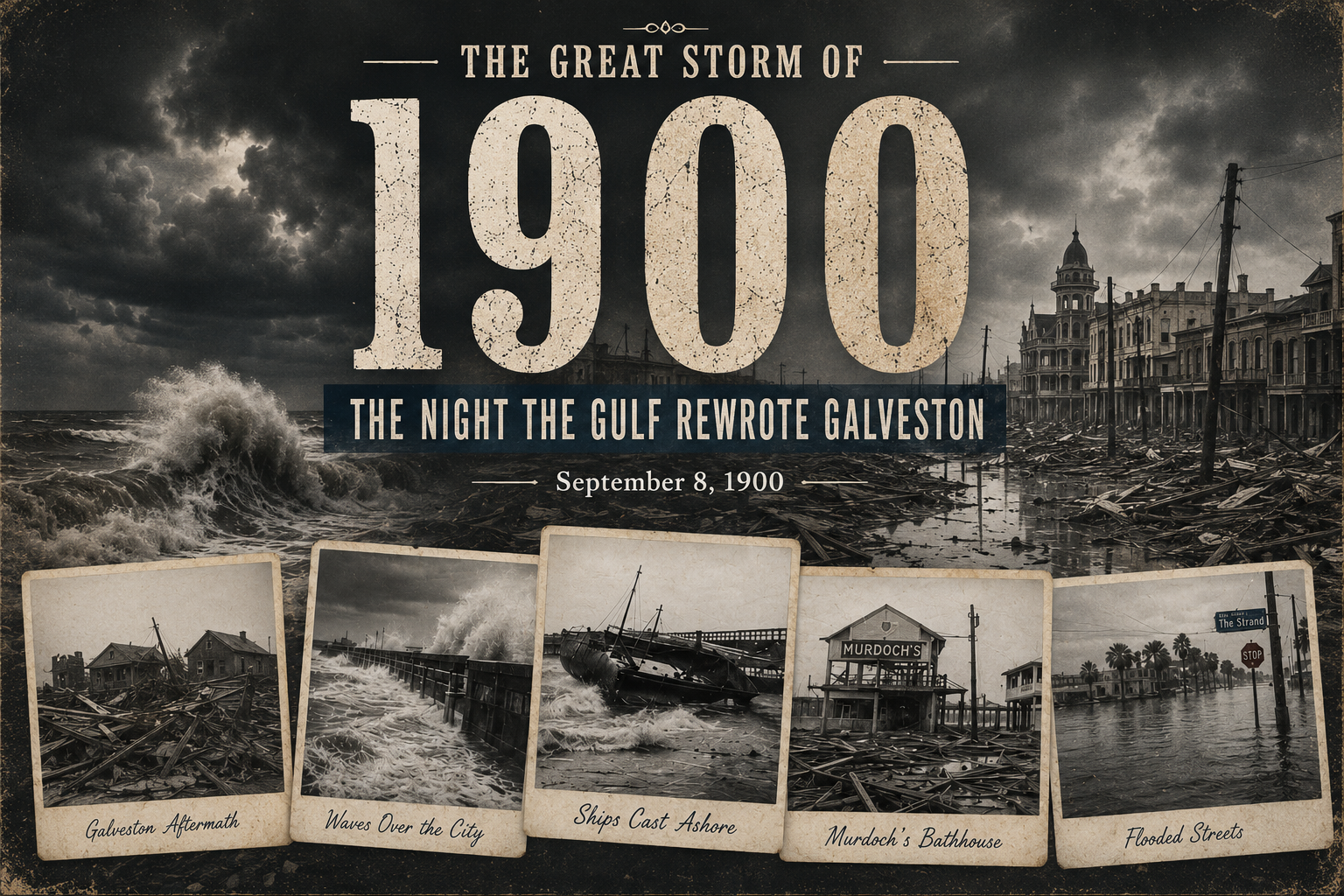
The Night the Gulf Rewrote Galveston
Before 1900, Galveston ranked among the most important cities in Texas.
The island served as a major port, financial center, and gateway to the Gulf of Mexico. Ships carried cotton, grain, lumber, and manufactured goods through its busy harbor. Railroads connected the docks to farms and cities across the state. Banks, hotels, churches, theaters, schools, and elaborate homes reflected a city that expected to keep growing.
Galveston had wealth, influence, and national importance.
It also sat dangerously low.
Most of the developed island stood only several feet above sea level. No seawall separated the city from the Gulf. No substantial dune system or barrier protected the homes closest to the beach. When storms approached, residents relied on limited forecasts, telegraph reports, local experience, and the hope that the worst weather would turn elsewhere.
On September 8, 1900, that hope failed.
At a Glance
Date: September 8, 1900
Estimated strength: Powerful Category 4 hurricane by modern estimates
Estimated winds: Around 120 to 135 mph
Storm tide: Approximately 8 to 15 feet
Galveston homes destroyed: 2,636
Estimated property losses: Between $28 million and $30 million at the time
Estimated deaths: Roughly 8,000 people on Galveston Island, with additional deaths on the mainland
Legacy: The deadliest natural disaster in United States history
Warnings in a Different Age
The hurricane had traveled through the Caribbean and into the Gulf of Mexico, but weather forecasting remained primitive in 1900.
There were no satellites, radar systems, reconnaissance aircraft, computer models, emergency phone alerts, or live broadcasts. Information traveled by ship reports, telegraph messages, newspaper notices, and observations taken at weather stations.
Forecasters knew disturbed weather existed in the Gulf. They did not know precisely where the center would travel or how powerful the system had become.
Galveston residents had experienced storms before. Many believed the island could withstand another one. Some had even rejected the idea that a major hurricane could produce a disastrous surge across the city.
The island’s flat geography offered no high ground, but the danger remained difficult to imagine until the water had already begun rising.
By the morning of September 8, the Gulf had become rough. Waves crossed parts of the beach. Rain fell across the island. The wind strengthened steadily.
Weather Bureau observer Isaac Cline recognized that conditions were becoming dangerous. He traveled through low-lying areas and urged residents near the beach to seek stronger shelter.
By then, time had nearly run out.
The Water Came First
As the hurricane approached, Gulf water began covering streets near the beach.
The island’s elevation offered little resistance. Water moved inland, filled yards, crossed roads, and entered homes. Residents carried children upstairs. Families climbed into attics. Neighbors gathered inside larger buildings that appeared strong enough to survive.
The water kept rising.
By late afternoon and evening, the hurricane had reached Galveston with estimated winds exceeding 120 mph. The storm tide climbed several feet above the island’s normal elevation, allowing the Gulf to sweep across entire neighborhoods.
Wooden houses broke loose from their foundations. Some floated until they collided with other structures. Roofs lifted. Walls collapsed. Telegraph poles snapped. Streetcar lines disappeared beneath water and debris.
Thousands of pieces of wreckage moved through the flooded city.
Boards, roofing, furniture, wagons, fences, boats, and sections of destroyed homes formed a moving mass. Wind and water drove that debris into buildings that had survived the first impact.
The wreckage began collecting near parts of the city in a huge wall of debris. Houses behind it faced crushing pressure from water, timber, and collapsing structures.
Families who had believed they had found shelter suddenly watched the buildings around them fail.
St. Mary’s Orphan Asylum
One of the storm’s most remembered tragedies occurred at St. Mary’s Orphan Asylum.
The orphanage stood near the Gulf and housed 93 children under the care of the Sisters of Charity of the Incarnate Word. As the storm worsened, the sisters moved the children into the girls’ dormitory, which they believed offered the strongest protection.
The sisters reportedly tied groups of children together with clothesline so they would not become separated.
The building collapsed under the force of the storm.
Ten sisters and 90 children died. Only three boys survived.
The deaths at the orphanage became one of the clearest symbols of the disaster, but similar scenes unfolded throughout Galveston. Entire families disappeared. Parents lost children. Children lost parents. Neighbors watched people vanish into dark water filled with wreckage.
There was little anyone could do once the buildings began collapsing.
A City in Darkness
Electric service failed. Telegraph connections went down. Lamps broke or went out. Residents trapped inside damaged structures could hear buildings collapsing nearby but could not see how close the destruction had come.
The hurricane continued through the evening.
People clung to floating wreckage, rooftops, rafters, and sections of walls. Some moved between buildings as structures weakened. Others sheltered in schools, churches, warehouses, and large homes.
Several substantial buildings survived and protected hundreds of people, but even strong masonry structures suffered damage.
The Tremont Hotel sheltered residents and visitors. The Ursuline Academy also survived and became a refuge. Other buildings that had appeared equally secure collapsed or lost sections beneath the impact.
Survival often depended on location, construction, timing, and chance.
By the time the storm moved inland, Galveston had endured hours of violent wind, rising water, and structural collapse.
No one yet understood how much of the city had vanished.
The Morning After
When daylight returned on September 9, survivors stepped into a city they barely recognized.
Whole neighborhoods had been flattened. Streets had disappeared beneath lumber and mud. Houses sat twisted against other buildings. Boats rested far from the waterfront. Railroad tracks, telephone lines, streetcar systems, and utility equipment had been destroyed.
The familiar layout of Galveston had become difficult to follow.
Survivors searched through wreckage for relatives, friends, food, clean water, and anything they could use as shelter.
The scale of death overwhelmed the city.
Thousands of bodies lay beneath debris or in standing water. Others had been carried away by the Gulf. Many victims could not be identified.
Galveston had lost roughly one-fifth of its population in a single night.
The exact death toll will never be known. Local historical records place the number on Galveston Island at approximately 8,000, with several thousand additional deaths possible elsewhere along the storm’s path. More than 2,600 houses were destroyed, and thousands of other structures suffered damage.
The survivors still faced another crisis.
They had to keep the ruined city alive.