Speckled Trout Fishing on Galveston Island: Where to Find Them, What to Throw, and When to Go
Speckled Trout Fishing on Galveston Island: Where to Find Them, What to Throw, and When to Go
Speckled trout are one of the fish that can turn an ordinary morning on Galveston Island into a reason to come back tomorrow.
Officially called spotted seatrout, specks are among the most popular game fish on the Texas coast. They hit live bait. They chase artificial lures. They feed in the bays, around structure, near jetties, under lights, and sometimes close enough to the Galveston beachfront that anglers can reach them without ever stepping onto a boat.
That last part matters.
Galveston Island gives shore-based anglers access to the Gulf on one side and the Galveston Bay system on the other. Add piers, rock structure, passes, beach guts, channels, and lighted water, and there are several different ways to target speckled trout while keeping both feet on the island.
Catching them consistently takes more than buying shrimp and hoping for divine intervention, though.
The best trout anglers pay attention to the water.
Meet the Speckled Trout
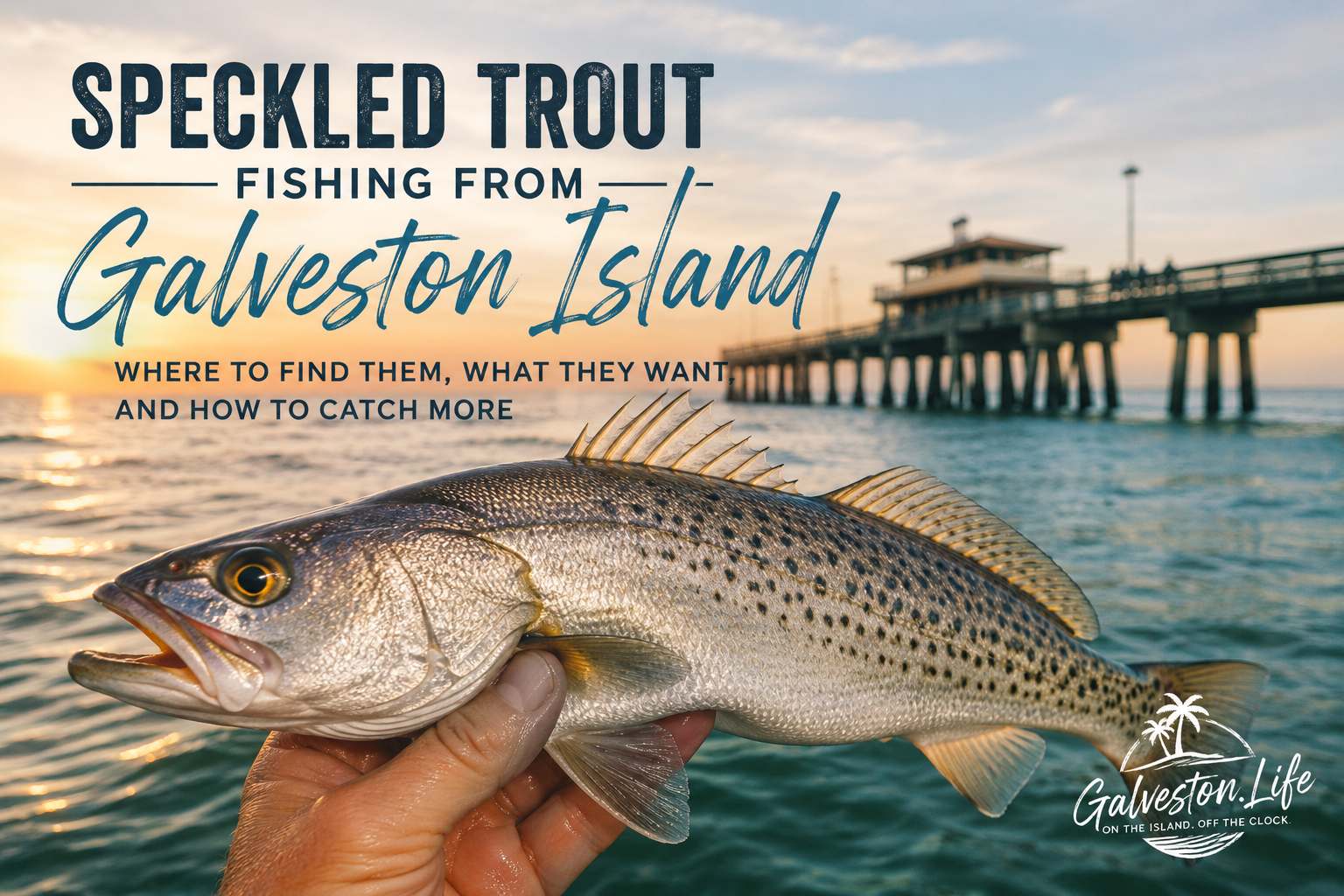
Speckled trout are easy to recognize once you know what you are looking for.
The fish usually have a silver body with a darker greenish or gray back. Black spots cover the upper body and extend onto the fins and tail. Their mouths contain noticeable canine teeth, particularly on larger fish.
Despite the name, a speckled trout is not a true freshwater trout. It belongs to the drum family along with redfish and black drum.
Texas Parks and Wildlife Department lists spotted seatrout as one of the state’s coastal game fish and describes the species as a shallow-water predator commonly associated with reefs, marshes, and other productive coastal habitat. Young trout feed heavily on shrimp and small crustaceans. Fish become increasingly important in their diet as they grow.
That feeding behavior gives Galveston anglers a useful starting point.
If you find the food, you have a much better chance of finding the trout.
Where to Find Speckled Trout From Galveston Island
There is no single “speckled trout spot” on Galveston Island that works every day.
Trout move.
Wind changes.
Tides move bait.
Water clarity can improve overnight and disappear again before lunch because the Gulf apparently resents predictability.
Instead of memorizing one location, learn the kinds of water that attract feeding trout.
The Galveston Surf
The beachfront is one of the most exciting places to catch speckled trout from the island.
When Gulf conditions settle and cleaner water reaches the beach, trout can move into the surf to chase shrimp, mullet, and small baitfish.
The mistake many new surf anglers make is assuming every fish lives somewhere beyond the horizon.
They do not.
Galveston’s beach has sandbars with deeper troughs, usually called guts, running between them. Those guts create natural travel lanes for bait and predators.
Sometimes the productive water is surprisingly close to shore.
Before casting, watch where the waves break. Breaking waves often reveal the location of a sandbar. The deeper water before or behind that bar may form a gut.
Then watch the bait.
Mullet jumping repeatedly in one area can mean something is disturbing them below. Small baitfish showering out of the water deserve even more attention. Birds repeatedly diving into one section of water can reveal feeding activity.
A hundred-yard cast looks impressive.
A thirty-yard cast into feeding trout catches more fish.
Piers and Pilings
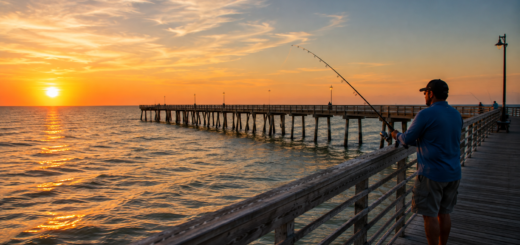
Fishing piers give anglers something the open beach does not.
Structure.
Pilings collect marine growth and attract small organisms. Small fish gather around them. Larger predators follow the smaller fish because nature has been recycling that arrangement for several hundred million years.
Speckled trout may travel along pier structure or feed near areas where current moves bait past the pilings.
At night, lights add another advantage.
Artificial lighting attracts tiny organisms, shrimp, and baitfish. Trout can use the boundary between illuminated and darker water as an ambush point.
Do not assume the brightest spot contains the fish.
Cast beyond the light and retrieve your lure through the edge. Work parallel to the transition between bright and dark water when the layout allows it.
And if several people are already fishing the same light, do not repeatedly throw across everybody else’s lines.
That technique catches mostly profanity.
Jetties and Rock Structure
The Galveston area gives anglers access to substantial rock structure, including the island’s jetty systems.
Jetties create exactly the sort of environment predators use.
Current pushes water around and through gaps in the rocks. Bait gathers along current breaks. Deeper water sits within casting distance in many areas.
Texas Parks and Wildlife specifically includes spotted seatrout among fish associated with Texas jetty habitat.
Look beyond the physical rocks and watch how the water behaves around them.
A point where current sweeps past structure can be more productive than randomly casting directly against the rocks. So can a calmer pocket immediately behind a current break.
The downside is that rocks eat tackle with impressive efficiency.
Bring extra leaders and jig heads.
More importantly, watch the Gulf. Wet rocks become slick, waves can wash farther onto the structure than expected, and strong current deserves respect whether the fish are biting or not.
No trout is worth being swept into the Gulf.
Bayside Shorelines, Channels, and Marsh Edges
The bay side of Galveston Island offers a completely different trout environment.
Speckled trout naturally use bays, estuaries, marsh habitat, reefs, and shallow feeding areas.
For shore-based anglers, places where shallow water meets deeper water deserve attention.
Look for channels, drop-offs, drains, points, shell, moving water, and areas where bait must pass through a relatively narrow space.
TPWD fishing reports from the Galveston Bay system repeatedly document trout around cuts, drop-offs, shell, drains, and other transition areas, with soft plastics, suspending lures, and shrimp-style presentations producing fish.
That gives you another basic trout rule.
Do not fish featureless water when better water is available.
Find something different.
Different depth. Different current. Different bottom. Different structure.
Predators use edges.
San Luis Pass and the West End
The far western end of Galveston Island puts anglers near moving water connecting the Gulf and bay system.
That movement can concentrate bait and attract multiple game species, including trout.
It also demands caution.
San Luis Pass is known for strong, changing currents. Areas around passes should never be treated like ordinary protected shoreline.
Fish from safe and legal areas. Pay attention to posted restrictions. Do not wade into strong moving water because somebody twenty feet farther out caught something.
There will be another fish.
You only get the one body.
The Simplest Speckled Trout Bait: Live Shrimp
If somebody is completely new to Galveston saltwater fishing and wants to catch a speckled trout, live shrimp is one of the easiest places to begin.
TPWD identifies live shrimp as one of the traditional natural baits for spotted seatrout.
A popping cork makes it even more beginner-friendly.
The setup suspends the shrimp at a chosen depth while the cork gives the angler a visible strike indicator. Working the cork also creates sound and disturbance that can attract nearby fish.
The trick is not to attack the water with it.
Pop the cork.
Pause.
Let the shrimp settle.
Repeat.
If nothing happens, change something.
Adjust the depth. Change the amount of time between pops. Move to a different section of water.
The purpose is to find feeding fish, not prove that you can make a cork produce noise for four consecutive hours.
Live Baitfish
Small baitfish can also produce excellent trout.
Mullet and other legal live baits become especially relevant because larger spotted seatrout increasingly feed on fish rather than relying primarily on shrimp and small crustaceans.
Watch what is naturally present where you are fishing.
If schools of small mullet are moving through the area, a bait or lure that resembles a mullet makes sense.
If tiny shrimp are everywhere, throwing something the size of a television remote may not be the brilliant act of deception you hoped it was.
Match the available food when possible.
Soft Plastics
For anglers who want to move beyond live bait, soft plastics are hard to beat.
A paddle-tail lure on a jig head can cover water quickly and imitate the small fish trout regularly eat.
Retrieve speed matters.
When trout are active, a steady retrieve may be enough.
When fish are holding deeper, slow the lure down.
Let it sink.
Work it closer to the bottom.
If trout are suspended somewhere between the surface and bottom, change the speed and depth until you start getting strikes.
That sounds painfully obvious.
Fishing has a remarkable ability to make people continue doing something that has failed for two hours because it worked once three Saturdays ago.
Change the presentation.
Suspending Lures
Suspending hard baits can be especially effective when trout are feeding on injured or slower-moving baitfish.
These lures allow an angler to retrieve, pause, twitch, and hold the bait in the strike zone longer than a lure that immediately sinks or floats away.
That pause can matter.
A trout may follow a moving lure without committing, then strike when the bait suddenly stops.
During cooler conditions, slower presentations often become particularly useful. TPWD trout guidance notes that fishlike artificial lures can be worked slowly during cold weather, while deeper channels and similar areas become worth targeting after strong winter fronts.
Topwater Trout Fishing
Then there is topwater fishing.
This is where sensible behavior starts deteriorating.
A topwater plug stays on the surface and creates movement that imitates injured or fleeing bait.
When a trout hits one, the strike can be violent enough to erase every previous memory of waking up too early.
Early mornings and other lower-light periods can produce good topwater opportunities when trout are actively feeding near the surface.
Do not immediately jerk the lure away when a fish explodes beside it.
That reaction is natural.
It is also an excellent method for stealing the lure directly out of the fish’s mouth.
Keep working the bait until you feel the fish load the rod, then set the hook.
Pay Attention to the Tide
People love asking for the perfect hour to catch trout.
The tide may matter more than the number on the clock.
Moving water moves food.
An incoming tide can carry Gulf water and bait toward shore, through passes, and into channels.
An outgoing tide can pull bait from shallower areas toward cuts, drains, and deeper water.
Neither incoming nor outgoing is automatically better everywhere on Galveston Island.
Look at how the current interacts with your location.
A piling, rock point, gut, channel edge, drain, or drop-off can create a feeding opportunity when current pushes bait past it.
If the water is completely dead and nothing around you appears alive, moving to an area with more current can make a huge difference.
Wind Can Make or Break the Surf
Wind changes Galveston fishing fast.
Strong onshore wind can rough up the Gulf, stir sediment, increase wave action, and make surf fishing far more difficult.
Periods of lighter wind can allow the beachfront to settle and improve visibility.
That does not mean trout require perfectly clear water.
They do not.
Galveston’s Gulf water is naturally influenced by sediment, wind, current, and the shallow upper Texas coast. Trout live here anyway, apparently having missed the internet discussions complaining that the water is not Caribbean blue.
Instead of obsessing over color alone, look for a combination of manageable water, bait, current, and feeding activity.
Watch for Feeding Slicks
This is one of the stranger pieces of legitimate trout fishing knowledge.
Feeding trout can create slicks on the water.
When trout regurgitate partially digested food while actively feeding, oils can rise to the surface and create a slick. TPWD notes that experienced anglers even identify trout slicks by a smell sometimes compared with watermelon or freshly cut grass.
A fresh slick may look like a smooth patch on otherwise textured water.
Not every slick means trout.
Not every trout creates an obvious slick.
But once you start watching for them, they become another clue.
Fishing gets considerably weirder when smelling the Gulf for watermelon becomes legitimate advice.
Night Fishing for Speckled Trout
Galveston does not stop being fishable when the sun disappears.
In some places, the opposite happens.
Lights around fishing structures can concentrate bait after dark. TPWD specifically notes that artificial lures can be effective under lights at night when trout gather to feed.
Start by figuring out what the trout are eating.
Tiny bait around a light usually calls for a smaller presentation.
Cast outside the brightest water and work the lure into or along the illuminated area.
If fish are visibly striking near the surface, adjust accordingly.
If nothing is happening above, work deeper.
Night fishing also lets anglers escape some of Galveston’s summer heat, which is useful because August occasionally appears determined to cook everyone directly on the Seawall.
A Basic Galveston Speckled Trout Setup
You do not need a tackle collection large enough to require probate instructions.
A medium-light or medium spinning rod around seven feet can handle many common trout situations around Galveston. Pair it with a spinning reel sized for inshore saltwater use, appropriate main line, and a leader suitable for the water and structure you are fishing.
For artificials, carry a few paddle tails, jig heads in more than one weight, a suspending lure, and a topwater option.
For live bait, a popping cork setup and simple free-line or lightly weighted rig will cover a remarkable amount of water.
Pier, jetty, and heavy-current situations may require stronger equipment.
The important part is matching the tackle to where you are fishing rather than trying to build one rod capable of catching everything from a ten-inch trout to a shark with unresolved anger issues.
Spring Trout Fishing
Spring brings warming water and increasing bait activity.
Trout begin using more shallow feeding areas as conditions improve, while changing fronts and wind can make individual days wildly different.
When the Gulf is rough, protected bayside water may provide better opportunities.
When conditions settle, start checking the surf and more exposed structure.
Spring rewards flexibility.
Summer Trout Fishing
Summer gives Galveston anglers some classic opportunities.
The beachfront becomes especially interesting when the Gulf settles and bait moves close to shore.
Early morning fishing can provide better surface activity while avoiding the worst afternoon temperatures.
After dark, lighted water gives anglers another option.
Summer is also when heat safety becomes non-negotiable.
Bring more water than you think you need.
Sun protection matters.
A successful fishing trip becomes considerably less charming once somebody develops heat exhaustion.
Fall Trout Fishing
Fall can bring aggressive feeding as water temperatures begin dropping and shrimp and baitfish move through the bay system.
This is when birds become particularly useful.
Schools of feeding trout can push shrimp and small fish toward the surface. Gulls notice.
TPWD notes that groups of feeding gulls can reveal schooling trout chasing prey near the surface, particularly during summer and fall.
If birds repeatedly work one area rather than casually wandering around looking judgmental, pay attention.
Something may be feeding underneath them.
Winter Trout Fishing
Winter does not end trout fishing.
It changes where you look and how you fish.
Deeper channels, cuts, and areas with more stable temperatures become increasingly important during colder periods.
Slow down.
A lure that looked painfully slow during summer may suddenly be exactly right.
TPWD’s Galveston-area reports from early 2026 documented trout using deeper cuts, shell beds, drop-offs, and transition zones during colder conditions, with slow presentations producing fish.
Do not assume cold weather means no trout.
It may simply mean the trout stopped hanging out where you caught them in July.
Texas Speckled Trout Regulations
Speckled trout are regulated game fish in Texas.
As of August 21, 2026, the regulations currently in effect allow a daily bag limit of three spotted seatrout per angler. The regular legal length range is 15 to 20 inches, and the possession limit is twice the daily bag limit. TPWD also has specific tag provisions allowing limited retention of spotted seatrout longer than 28 inches.
TPWD has already published the regulations that take effect September 1, 2026. The three-fish daily limit and 15-to-20-inch regular length range remain in place for the 2026-2027 license year.
Anyone fishing Texas public saltwater generally needs a current Texas fishing license with the appropriate saltwater endorsement unless an exemption applies.
Always check the current Texas Parks and Wildlife Outdoor Annual before keeping a fish.
Do not rely on an old screenshot, an old social media post, or the guy three coolers down who is absolutely certain the limit was different in 2017.
Fishing regulations change.
Handling and Keeping Speckled Trout
If a trout is legal and you intend to keep it, get it chilled quickly.
TPWD notes that spotted seatrout have delicate meat that loses quality rapidly when left warm, particularly during hot weather.
If you plan to release the fish, minimize handling and return it to the water as quickly as practical.
Wet hands before handling it.
Support the fish instead of letting it hang unnecessarily.
Have your camera ready before taking the fish out of the water if you want a picture.
The photo does not improve during minute four.
The fish definitely does not.
Anglers keeping fish from portions of the greater Galveston Bay system should also pay attention to location-specific Texas fish-consumption advisories. TPWD currently lists a spotted-seatrout consumption advisory for Upper Galveston Bay north of a defined boundary, along with separate advisories affecting other species and portions of the bay system.
The Real Secret to Catching Galveston Speckled Trout
There is no magic Galveston trout lure.
There is no single perfect tide.
There is no secret color that makes every trout within a mile abandon good judgment.
The anglers who catch trout consistently usually do something much less exciting.
They pay attention.
They notice bait.
They notice current.
They notice where the water changes depth.
They notice when birds start working.
They change lure depth when fish are not hitting.
They move when an area looks dead.
They remember what happened the last time the Gulf looked like this.
Galveston Island gives anglers a remarkable amount of trout water without requiring a boat. You can work the surf before breakfast, fish structure during moving water, throw shrimp beneath a cork, walk artificial lures through likely areas, or spend the night watching trout chase bait around lights.
Some days everything lines up.
The tide moves. The bait shows up. The water settles. The trout feed.
Other days you can offer a speckled trout the finest live shrimp available on the Texas coast and receive absolutely nothing in return.
That is part of it.
Because once you finally feel that hit, watch the line move, and bring a spotted silver fish out of Galveston water, there is really only one reasonable response.
Make another cast.