Pier Fishing on Galveston Island: What to Bring, What Bites, and How to Fish It
Pier Fishing on Galveston Island: What to Bring, What Bites, and How to Fish It
Pier fishing is one of the easiest ways to get into saltwater fishing on Galveston Island.
You do not need a boat.
You do not need to wade chest-deep into the Gulf.
You do not need enough tackle to fill the back of a truck.
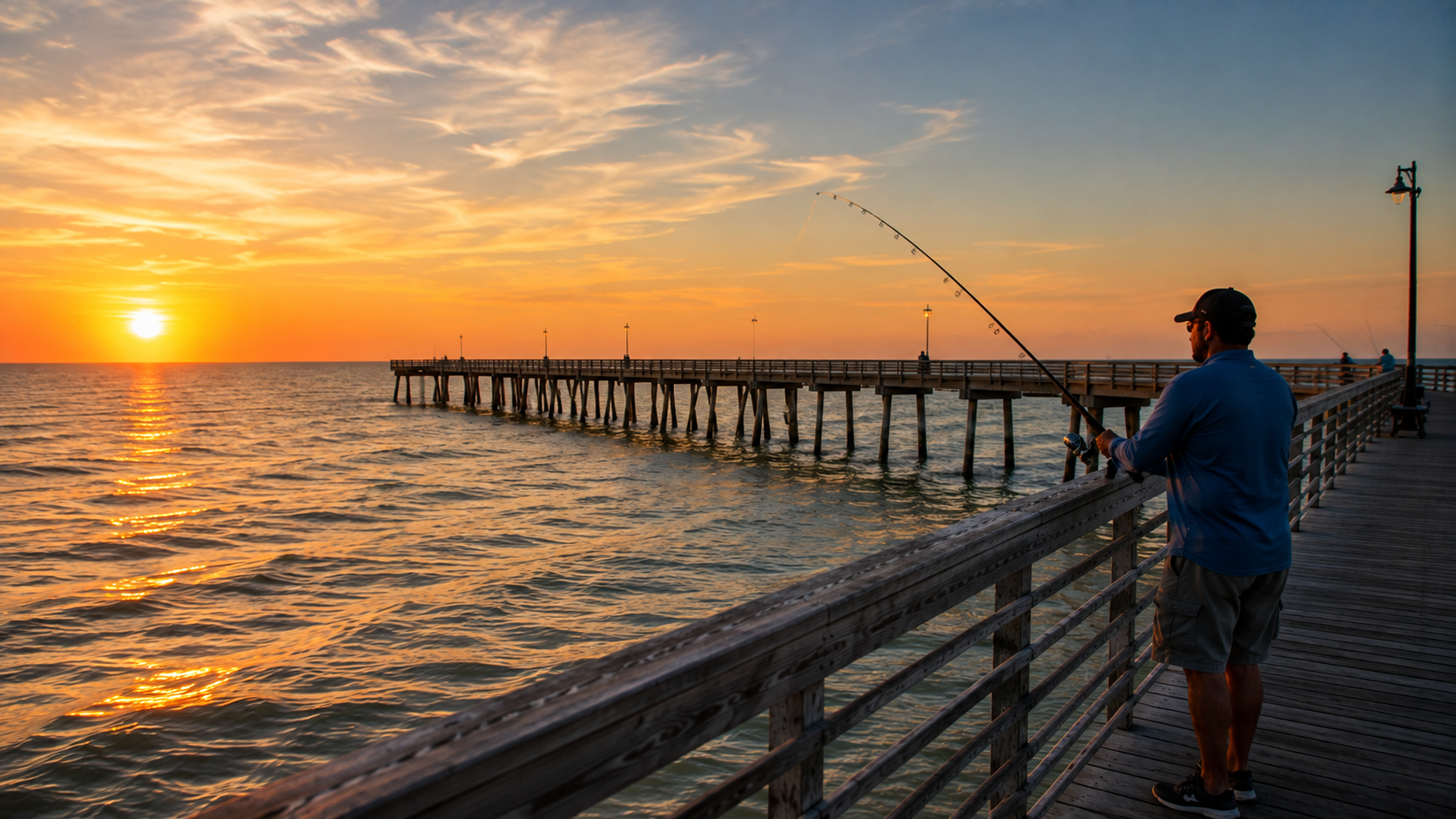
You can walk out over the water, drop a bait beside the structure, cast into the surf, fish under the lights after dark, and have a legitimate chance at everything from croaker and whiting to speckled trout, redfish, black drum, Spanish mackerel, sharks, and whatever other Gulf creature decides to ruin the plan you had when you tied the rig.
That unpredictability is part of the appeal.
Pier fishing gives anglers access to water that would otherwise require a boat or a very ambitious cast from the beach. It also creates structure, shade, current breaks, and nighttime lighting that attract baitfish and predators.
For someone new to Galveston fishing, a pier is one of the best places to start.
Why Piers Hold Fish
A fishing pier is more than a long walkway over water.
Every piling changes the environment around it.
Barnacles, algae, small crustaceans, and other marine life grow on hard structure. Small fish gather around it. Shrimp and baitfish move through the pilings with the current. Predators follow.
The pier also crosses several different depths.
Near the beach, anglers may be fishing the first and second guts of the surf.
Farther out, the water becomes deeper.
That means anglers standing on the same pier can be targeting completely different fish depending on where they choose to set up.
At night, lights add another layer.
Texas Parks and Wildlife has specifically noted that Gulf pier lights can attract bait and create strong summer opportunities for spotted seatrout, especially when anglers fish live shrimp beneath popping corks around illuminated water.
In other words, the pier does part of the fish-finding work for you.
You still have to convince the fish to cooperate, which is unfortunately where the arrangement becomes less convenient.
Galveston Fishing Pier
One of the most recognizable places to fish directly from Galveston Island is the Galveston Fishing Pier at 9001 Seawall Boulevard.
The pier extends from the Seawall over the Gulf and gives anglers access to multiple sections of the surf without requiring a boat. The pier currently offers rod rentals, bait, tackle, and other fishing supplies on-site, making it especially easy for visitors or beginners who do not arrive with their own equipment.
Its summer schedule currently runs 24 hours a day from the second Saturday in March through the weekend after Thanksgiving, with winter hours of 7 a.m. to 11 p.m. Weather can change access, so current hours should always be checked before heading out.
The important thing from a fishing standpoint is not simply that the pier reaches farther into the Gulf.
It crosses different water.
That gives anglers choices.
If fish are working close to the beach, there is no reason to automatically march to the end.
If bait is moving farther offshore, deeper sections of the pier may become more productive.
The fish do not care which spot has the better view.
What Can You Catch From a Galveston Pier?
The answer changes throughout the year.
That is one of the reasons pier fishing stays interesting.
A Galveston pier can produce smaller bottom fish one day and much larger game fish the next.
Common possibilities include:
Speckled Trout
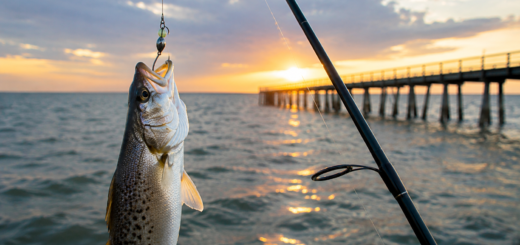
Speckled trout are one of the most sought-after pier fish along the Texas coast.
Warm-weather nights can be particularly productive around pier lights.
Look for baitfish or shrimp gathering near illuminated water. Trout may feed directly beneath the light, but they often work the darker edges where prey moving through the bright water becomes easier to ambush.
Live shrimp beneath a popping cork is one of the classic approaches.
Soft plastics and other small artificial lures can also be effective.
If you see trout feeding but they refuse your lure, look carefully at the size of the bait.
Matching the size of what they are already eating can matter more than cycling through seventeen colors because someone online swore chartreuse changed his life.
Redfish
Redfish can show up around Gulf piers in several size classes.
Smaller fish may feed on shrimp, crabs, and small fish around structure and the surf.
Larger bull reds sometimes move through Gulf waters and can turn a quiet bottom-fishing setup into something much more entertaining.
Texas Parks and Wildlife notes that red drum feed on crabs, shrimp, marine worms, and small fish, which explains why common pier baits such as shrimp, crab, and cut bait can all produce them.
A heavier bottom rig becomes useful when targeting larger reds.
Then comes the inconvenient part.
You have to get the fish from the water to the deck.
That is why pier anglers targeting larger fish often carry a pier net or drop net.
Trying to lift a big redfish several feet through the air by the fishing line is an excellent way to discover exactly where the weakest knot in your setup was hiding.
Black Drum
Black drum are another common Texas coastal species.
Smaller drum often take shrimp.
Larger fish strongly favor crustaceans such as crab.
Big mature drum sometimes move through Gulf surf during spawning periods, and Texas fisheries biologists have specifically documented large black drum moving past Gulf piers during late winter and early spring.
These fish can get heavy.
Very heavy.
A rod that feels perfectly adequate while catching croaker may suddenly seem like a questionable life choice when something the size of a kitchen appliance starts pulling against it.
Whiting
Whiting may not receive the attention given to trout and redfish, but they are one of the best fish for beginners.
They often feed in the surf close to the beach.
Fresh or dead shrimp on a simple bottom rig can catch them.
You usually do not need giant hooks or enormous bait.
You also may not need to cast very far.
Whiting frequently use the guts running parallel to the beach, including water within easy casting range of the shallower sections of a pier.
They are also one of the fish most likely to reward someone who simply wants to catch something instead of spending six hours targeting one trophy fish that has apparently left the county.
Croaker
Atlantic croaker are common around the Texas coast and can be caught on shrimp, small pieces of cut bait, and other simple offerings.
They are another excellent beginner fish.
If you are bringing kids to a pier, smaller hooks and small pieces of shrimp can produce much more action than rigging every rod for something enormous.
Catching fish tends to keep children interested in fishing.
Watching an untouched shark bait soak for four hours tends to produce very different results.
Gafftop and Hardhead Catfish
Saltwater catfish are part of pier fishing whether anyone invited them or not.
Hardhead catfish are extremely common.
Gafftopsail catfish can grow larger and fight surprisingly well.
Both have sharp spines.
Handle them carefully.
Do not grab one casually because it looks like a harmless little catfish.
Hooks, fish slime, darkness, and sharp spines combine into the kind of decision-making environment emergency rooms probably appreciate financially.
Spanish Mackerel
When warm water and bait move along the Gulf beachfront, Spanish mackerel can come within range of piers.
These are fast predators.
Spoons, jigs, and other small flashy lures can work well when fish are actively chasing bait.
Watch for birds and baitfish activity.
If small fish suddenly start spraying out of the water, throwing a lure through the area is generally more useful than standing there discussing what might be chasing them.
Spanish mackerel also have sharp teeth.
Leader choice matters.
Sharks
Yes, sharks.
Several species of shark move through the Gulf waters around Galveston.
Pier anglers sometimes target them intentionally with heavier tackle and large baits, while smaller sharks regularly surprise people who were fishing for something completely different.
Shark fishing requires stronger tackle, proper handling equipment, knowledge of current regulations, and an actual plan for landing and releasing the fish.
A six-foot shark is not the moment to begin improvising.
Stingrays
Stingrays also take bottom baits around Galveston.
They can fight much harder than their flat shape suggests.
If you bring one to the surface, remember why the word “sting” appears directly in the name.
Use appropriate tools and give the tail room.
The fish does not need to be angry at you personally for this to become an extremely memorable mistake.
What Bait Works Best From a Pier?
There is no single bait that catches everything.
There are, however, several reliable options.
Shrimp
Shrimp may be the most useful all-around pier bait.
Live shrimp can catch trout, redfish, drum, and several other species.
Dead shrimp catches whiting, croaker, catfish, drum, and plenty of additional bottom feeders.
For beginners, shrimp gives you a legitimate chance at catching something without requiring complicated rigging.
Keep bait size reasonable.
A small fish has a difficult time eating a shrimp chunk approximately the size of its own head.
Cut Mullet
Cut mullet is excellent when targeting larger predators and bottom feeders.
Redfish, sharks, gafftop, and several other species will take it.
Fresh cut bait releases scent into the water, which becomes particularly useful when visibility is poor.
Galveston water does not always provide aquarium-level visibility.
The fish somehow cope.
Crab
Crab is one of the best options for drum and can also attract redfish.
Pieces of blue crab can be placed on stronger hooks and fished on the bottom.
If you specifically want a large black drum rather than whatever happens to swim past, crab deserves a place in the bait cooler.
Squid
Squid is cheap, durable, and difficult for small fish to steal.
That makes it useful for general bottom fishing.
It is not always the most natural local bait choice, but the fact that it stays on the hook is a powerful argument after your fifth shrimp disappears without producing a fish.
Artificial Lures
Piers also give artificial-lure anglers plenty of options.
Soft plastics can target trout and redfish.
Spoons can catch Spanish mackerel and other predators.
Topwater plugs can produce exciting trout strikes during the right conditions.
Jigs can be worked at different depths around bait schools and structure.
The major advantage of artificials is movement.
Instead of waiting for fish to locate a stationary bait, you can cover water and search for active fish.
The Basic Bottom Rig
If you are new to pier fishing, a basic bottom rig is difficult to beat.
The idea is simple.
A weight keeps the bait near the bottom while the hook holds shrimp, cut bait, squid, or another natural bait.
Several variations work, including single-hook fish-finder rigs and multi-hook rigs.
Do not make the system more complicated than necessary.
Match your sinker weight to the current.
Use enough weight to keep the bait where you want it.
If your line continually sweeps into everyone else’s fishing area, you probably need more weight or a different casting angle.
Popping Corks From the Pier
A popping cork is especially useful when targeting trout and redfish higher in the water column.
Live shrimp beneath the cork is a classic combination.
Adjust the leader length based on depth.
Pop the cork.
Let the bait settle.
Watch closely.
If the cork disappears, resist the human urge to spend three seconds wondering whether that counted.
Reel.
Do Not Automatically Fish the End
New pier anglers often assume farther means better.
That is not how fish work.
Different sections of the pier cross different parts of the surf.
The inside guts can hold whiting, trout, redfish, pompano, croaker, and plenty of other fish.
Farther sections may give access to deeper water and species traveling outside the bars.
Before choosing a spot, look at what is happening.
Where are people actually catching fish?
Where is bait moving?
Where are birds working?
Where does the water change?
Fishing twenty feet from the entrance can be better than fishing at the very end.
The fish did not pay admission and therefore feel no obligation to distribute themselves fairly.
Watch the Water Before You Cast
This is one of the easiest ways to become a better pier angler.
Spend a few minutes looking.
Find the sandbars.
Notice the wave breaks.
Watch the current around the pilings.
Look for schools of mullet.
Watch for small baitfish jumping.
Pay attention to birds.
Look for color changes in the water.
Observe what successful anglers are doing without becoming the stranger hovering directly over their shoulder.
The water usually gives clues.
Night Pier Fishing
Night fishing deserves special attention in Galveston.
Summer heat drops.
Crowds can change.
Lights create feeding zones.
Bait gathers around illuminated water, and predators can move in beneath it.
Trout are an obvious target, but other species remain active after dark as well.
Use smaller lures when trout are feeding on tiny bait.
Work the edges of the lights.
Try different depths.
And bring lighting that lets you tie knots without holding a flashlight in your teeth like civilization never happened.
A headlamp is cheap.
Buy one.
What to Bring Pier Fishing
You do not need to carry your entire garage.
A basic pier fishing kit should include:
- Rod and reel appropriate for the fish you want to target
- Current Texas fishing license and saltwater endorsement when required
- Hooks in several sizes
- Sinkers in several weights
- Leader material
- Swivels
- Pliers
- Line cutters
- Extra rigs
- Bait
- Small tackle box
- Cooler if you plan to keep legal fish
- Measuring device
- Headlamp for night fishing
- Sunscreen
- Water
- Hand towel
- Pier net or drop net if targeting larger fish
The current Galveston Fishing Pier rules require anglers to follow Texas fishing regulations and carry the required Texas fishing license. The pier also allows coolers subject to its rules and provides bait, tackle, and rod rentals for anglers who arrive without gear.
Pier Etiquette Matters
Fishing beside dozens of strangers works surprisingly well when everybody behaves like a functioning adult.
Give other anglers room.
Do not repeatedly cast across their lines.
If a large fish starts running down the pier, move your rods when possible and let the angler follow it.
Keep hooks, knives, bait, and tackle contained.
Clean your fishing area.
Do not leave cut line on the deck.
Do not abandon hooks where somebody can step on them.
The Galveston Fishing Pier specifically requires anglers to keep their fishing areas clean and use the trash containers provided.
A fishing pier is shared space.
Nobody should need a tetanus shot because you lost interest in a leader.
Check the Weather Before Going
Pier fishing puts you over open Gulf water.
That deserves respect.
Wind can become stronger offshore than it feels from the street.
Thunderstorms can develop quickly.
Lightning and a long elevated structure surrounded by fishing rods are not a charming coastal combination.
Check the weather.
Watch the Gulf.
Follow pier closures and staff instructions.
If conditions become dangerous, leave.
The fish will remain irrational tomorrow.
Know the Regulations
Texas saltwater regulations apply to fish caught from Galveston piers.
Size limits, daily bag limits, possession limits, and special rules vary by species and can change.
Check the current Texas Parks and Wildlife Outdoor Annual before keeping fish.
Measure anything you are uncertain about.
If a fish is too short, too long where a maximum applies, or otherwise illegal to retain, release it promptly.
Do not base your decision on what someone remembers the rule being several years ago.
The fish does not become legal because four people agreed confidently.
The Best Part of Galveston Pier Fishing
Pier fishing is accessible in a way many other kinds of saltwater fishing are not.
A beginner can show up with basic tackle and shrimp.
A serious angler can bring specialized gear and target trophy fish.
Families can fish together without putting everyone on a boat.
Night anglers can chase trout under the lights.
Someone can catch their first croaker twenty feet away from another angler fighting a bull red.
That is what makes it fun.
You never quite know what is going to eat the bait.
You can make a plan.
You can choose the right rig.
You can watch the tide and study the wind.
You can bring exactly the bait you believe the fish want.
Then something completely different bends the rod.
Welcome to pier fishing in Galveston.