Best Bait for Saltwater Fishing on Galveston Island: What to Use and What It Catches
Walk into a Galveston bait shop for the first time and the options can make saltwater fishing look considerably more complicated than it needs to be.
Live shrimp. Dead shrimp. Mullet. Croaker. Crab. Squid. Finger mullet. Cut bait. Live baitfish. Frozen bait. Artificial lures pretending to be all of the above.
Meanwhile, somebody three spots down the pier is catching fish on a piece of shrimp that looks like it survived several previous fishing trips.
The truth is simpler.
There is no single best bait for every fish around Galveston Island. The best bait depends on what you want to catch, where you are fishing, what the water is doing, and what the fish are already eating.
The good news is that a handful of baits will cover almost everything a shore or pier angler is likely to encounter around the island.
If you are standing on a Galveston pier, fishing the surf, working rocks or jetties, or casting from accessible bayside water, these are the baits worth understanding first.
Live Shrimp: The Galveston All-Around Favorite
If you could only bring one natural bait for general Galveston saltwater fishing, live shrimp would make a very strong case for the job.
Nearly everything eats shrimp.
Speckled trout eat them.
Redfish eat them.
Black drum eat them.
Sheepshead eat them.
Flounder eat them.
Croaker, whiting, and plenty of other smaller species will happily take them too.
That does not mean every fish wants shrimp every day, but it makes live shrimp one of the safest choices when you do not know exactly what is feeding.
For speckled trout and redfish, one of the simplest ways to fish a live shrimp is beneath a popping cork.
The cork keeps the shrimp suspended at a controlled depth while creating sound and movement when worked. Pop the cork, let the shrimp settle, and give the fish time to find it.
Around deeper pier water or stronger current, shrimp can also be free-lined or fished with enough weight to keep it where the fish are feeding.
The important part is keeping the shrimp alive and reasonably healthy.
A lively shrimp kicking around beneath a cork does a considerable amount of the fishing for you.
A shrimp that has been cooking in warm bait-bucket water for three hours becomes much less convincing.
Keep the water oxygenated, avoid overcrowding the container, and keep the bait out of direct summer sun when possible.
Galveston August is capable of cooking shrimp before you ever put them on a hook.
Dead Shrimp: Cheap, Easy, and Far More Useful Than People Admit
Live shrimp gets the glamour.
Dead shrimp catches a ridiculous number of fish.
For someone fishing from the beach or pier who simply wants steady action, fresh dead shrimp is one of the easiest baits to use.
Whiting love it.
Croaker eat it.
Black drum eat it.
Redfish will take it.
Sheepshead may take it around structure.
Hardhead and gafftop catfish will find it with an enthusiasm nobody requested.
The major advantage of dead shrimp is convenience.
It stays in a cooler.
It does not need oxygen.
It does not require a bait bucket.
You can cut it into pieces sized for the fish you are targeting.
For smaller fish such as whiting and croaker, you usually do not need an entire shrimp. A small piece threaded securely onto the hook often works better.
Using a hook covered by a giant wad of bait can actually reduce hookups.
The fish needs access to the hook point.
Try not to bury the entire business inside enough shrimp to feed a small family.
Freshness matters too.
Fresh dead shrimp usually holds together and smells better than bait that has been repeatedly frozen, thawed, refrozen, forgotten in somebody’s truck, and somehow returned to circulation.
Fish may not be especially judgmental, but there are limits.
Mullet: One of the Most Important Baitfish Around Galveston
Mullet are everywhere around Galveston.
You see them jumping in the surf.
You see schools moving along the beachfront.
You see them around piers, channels, shorelines, and bayside water.
Predatory fish notice them too.
Mullet can be fished alive, whole, as finger mullet, or cut into chunks depending on what you are targeting.
For larger redfish, sharks, gafftop, and other predators, fresh cut mullet is one of the most dependable baits available.
It releases scent into the water while offering the natural profile of a baitfish local predators already recognize.
That scent becomes especially useful when Galveston water is stained.
Our Gulf water is not always clear enough for a fish to inspect your bait like a restaurant menu.
Predators rely on scent, vibration, and movement as well as sight.
A fresh chunk of mullet on the bottom gives them plenty to work with.
Cut Mullet for Redfish
If you are specifically targeting redfish from a Galveston pier or beach, cut mullet belongs near the top of the list.
Use a chunk large enough to resist smaller bait thieves but not so enormous that every bite becomes a mystery.
Keep the hook point exposed.
A fish-finder or Carolina-style bottom rig works well because it allows the bait to sit naturally while the sinker holds against current.
When fishing the surf, do not automatically throw the bait as far as humanly possible.
Redfish travel the guts between Galveston’s sandbars and can feed surprisingly close to shore.
Put bait where the fish are likely to move, not wherever your personal casting record happens to end.
Finger Mullet
Smaller mullet are excellent natural baits for trout, redfish, flounder, and other predators.
They can be free-lined, fished beneath a cork, or placed on a lightly weighted rig depending on depth and current.
Live finger mullet can be particularly useful when fish are obviously feeding on baitfish rather than shrimp.
Pay attention to what is around you.
If the surf is full of mullet and predators are crashing through them, offering something that resembles the existing buffet makes considerably more sense than insisting the fish develop a sudden interest in squid.
Blue Crab: The Heavy-Hitter Bait
Crab is not always the first bait beginners reach for.
It should be on the radar of anyone targeting large black drum or redfish.
Blue crab is a natural part of the Texas coastal food chain, and large drum in particular are built to crush crustaceans.
Pieces of crab can be fished on the bottom using stronger hooks and heavier tackle.
Depending on the size of the crab and fish you are targeting, anglers may use sections rather than an entire crab.
Removing some of the shell can release additional scent, but you still want enough structure left for the bait to stay on the hook.
Crab is also tougher than shrimp.
That helps when smaller fish are constantly stealing softer bait.
When a large black drum finds it, the question stops being whether the bait is durable enough and becomes whether the rest of your equipment was a good idea.
Squid: The Bait That Refuses to Leave the Hook
Squid has one major quality that keeps anglers buying it.
It stays attached.
Small fish can dismantle shrimp with astonishing efficiency.
Squid fights back.
The flesh is tough and can be cut into strips or small pieces. It works well for general bottom fishing and can catch croaker, whiting, catfish, snapper species around appropriate structure, and plenty of other opportunistic feeders.
It is particularly useful when you are introducing someone to fishing and want the bait to remain on the hook longer than eleven seconds.
Squid is not necessarily the first choice when targeting a specific trophy fish, but as an inexpensive, durable general bait, it earns its place in the cooler.
It also pairs well with shrimp on multi-hook bottom rigs when you are simply trying to figure out what is feeding.
Croaker as Bait
Live croaker has a long history as a Texas coastal trout bait.
Larger speckled trout are fish eaters, and a struggling baitfish creates exactly the movement that attracts predators.
Croaker is generally more relevant for anglers specifically targeting trout than for someone simply trying to catch anything that swims past a pier.
It also requires more effort than dead bait.
You need to keep it alive.
You need tackle suited to presenting it naturally.
And you need trout in the area.
If the goal is a casual family fishing trip, shrimp usually makes more sense.
If the goal is specifically to target trout and local conditions favor live baitfish, croaker can become much more interesting.
Cut Bait Does Not Have to Mean Mullet
Mullet is popular for a reason, but plenty of legal nongame baitfish can be used as cut bait under current Texas rules.
Freshness is often more important than the exact species.
Fresh oily fish releases scent.
That scent spreads through moving water and gives predators something to track.
For sharks, larger redfish, gafftop, and other scavenging or predatory fish, a fresh piece of appropriate baitfish can outperform something that has been frozen into geological material for six months.
One important rule matters here.
Texas does not allow game fish or pieces of game fish to be used as bait.
Know what you caught before turning it into bait.
“I thought it was probably legal” remains an unimpressive explanation when the game warden arrives.
What About Grocery Store Shrimp?
This catches people off guard.
Do not assume every bag of raw shrimp from a grocery store is legal fishing bait in Texas.
Texas bait regulations require shrimp used as bait in state waters to be native to the Gulf. Imported shrimp or non-Gulf shrimp cannot simply be taken from the grocery freezer and placed on a hook.
That rule exists partly because imported shrimp can carry diseases that threaten native shrimp populations.
If you want dead shrimp for bait, buying bait shrimp from a reputable local bait shop removes a considerable amount of uncertainty.
Galveston has no shortage of places willing to sell you shrimp specifically so you can give it to a fish.
What Bait Should a Beginner Buy?
If you are new to Galveston fishing and do not know what you want to catch, keep it simple.
Start with shrimp.
Live shrimp gives you the widest range of possibilities when trout and redfish are part of the goal.
Dead shrimp is cheaper and easier when you mainly want bites.
Add cut mullet if you want a chance at larger redfish, gafftop, or sharks.
Add squid if bait theft becomes relentless.
That small selection can cover a surprising amount of Galveston fishing.
You do not need eleven types of bait on your first trip.
Half of saltwater fishing is learning which things you brought that day were completely unnecessary.
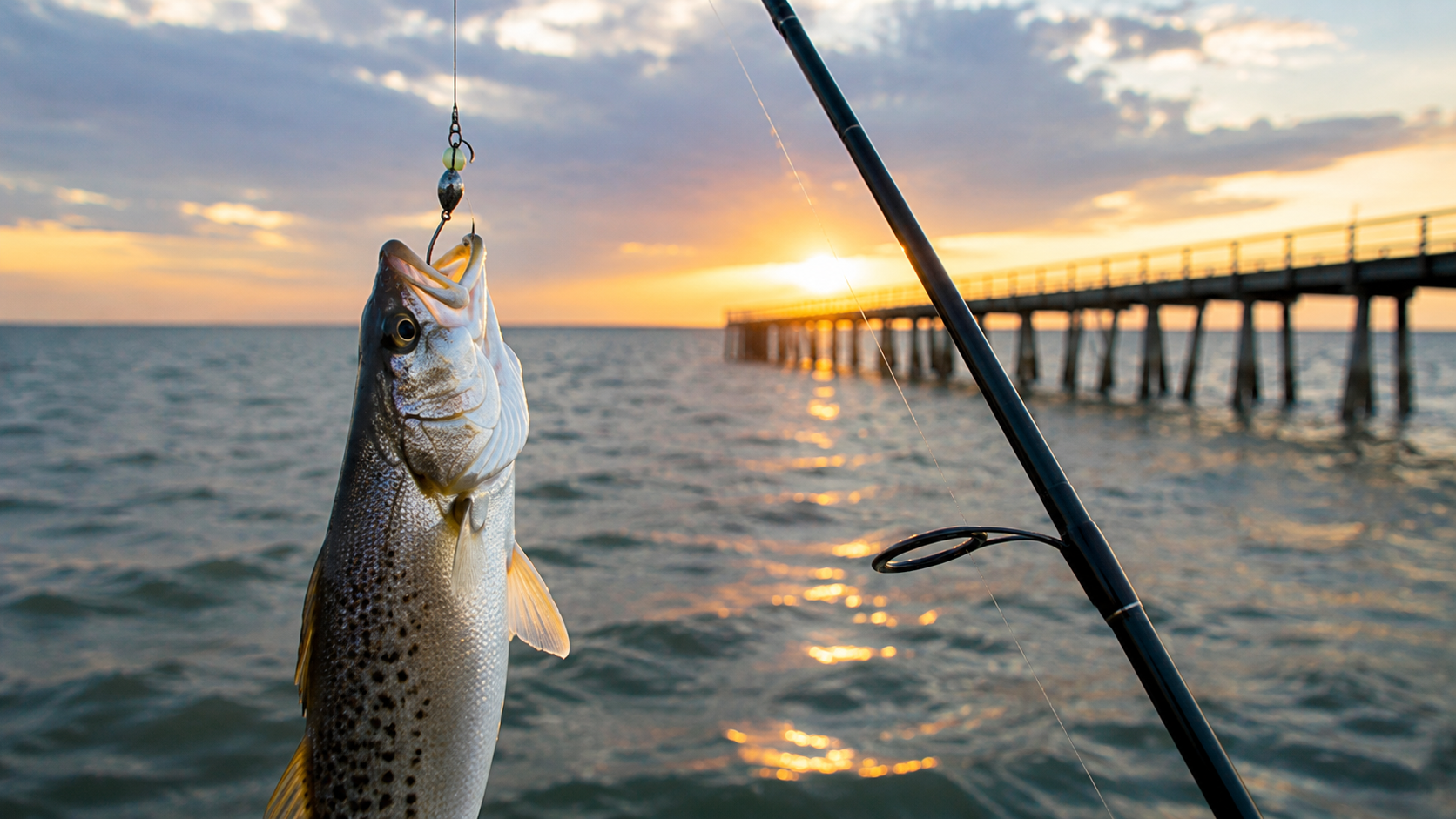
Best Bait for Speckled Trout
Live shrimp is one of the easiest and most dependable options.
Fish it beneath a popping cork around moving water, piers, bayside structure, and areas holding bait.
Live baitfish can become excellent alternatives when trout are feeding heavily on fish.
Artificial soft plastics, suspending lures, and topwaters also deserve attention, but when discussing natural bait, shrimp and small baitfish are the major players.
At night, watch the lights.
If tiny bait is gathering around illuminated water, match its size as closely as practical.
A trout feeding on tiny glass minnows may ignore something much larger even when that bait would normally work.
Best Bait for Redfish
Redfish are considerably less delicate about dinner.
Shrimp works.
Mullet works.
Crab works.
Cut bait works.
For smaller reds around structure or bayside water, live shrimp can be excellent.
For larger fish in the surf or around deeper pier water, cut mullet and crab become particularly attractive choices.
Fresh bait and moving water can be a powerful combination.
Put the bait where current carries scent naturally through likely travel lanes.
Best Bait for Black Drum
Shrimp catches plenty of smaller black drum.
For the giants, crab becomes much more interesting.
Large black drum have powerful crushing teeth in the throat designed for hard prey such as crabs and shellfish.
If your goal is specifically a big drum, a chunk of crab on a stout bottom rig makes far more sense than a tiny piece of shrimp.
Then make sure you have a way to land the fish.
Discovering that your bait worked perfectly immediately before discovering that your pier net is in the garage creates a very specific kind of disappointment.
Best Bait for Whiting and Croaker
Do not overthink this.
Shrimp.
Small pieces of fresh or dead shrimp on relatively small hooks can produce excellent action in the surf.
Whiting often feed in the beach guts much closer to shore than new anglers expect.
Croaker may show up in similar water and around piers.
These are perfect fish for beginners because you do not need massive equipment, giant baits, or complicated techniques.
Sometimes the simplest fishing is also the fishing where somebody actually catches something.
Best Bait for Sheepshead
Sheepshead love crustaceans.
Shrimp works.
Small crabs can work.
Other natural crustaceans found around legal fishing areas can be effective.
The bigger issue with sheepshead is presentation.
They have a reputation for stealing bait without giving the angler much warning.
Use a smaller, strong hook and keep the bait compact.
Fish close to structure such as pilings or rocks where sheepshead feed on barnacles and other marine life.
If your bait disappears repeatedly without the rod moving much, congratulations.
You may already be sheepshead fishing.
Best Bait for Sharks
Shark fishing requires an entirely different level of planning.
Fresh cut bait such as mullet is commonly used because sharks can locate scent from considerable distances.
Larger baits may be used for larger sharks.
That does not mean throwing an enormous bait from a pier with whatever rod happened to be available.
Targeted shark fishing requires appropriate tackle, safe landing tools, knowledge of species identification, and current Texas regulations.
Several shark species have specific harvest rules, and some species are prohibited from retention.
If you cannot identify the shark, treat it as a release.
The Gulf contains plenty of fish capable of turning casual equipment into expensive confetti.
Fresh Bait Usually Beats Ancient Bait
Frozen bait is useful.
Properly frozen fresh bait can work very well.
Repeatedly thawed and refrozen bait is another story.
It becomes soft.
It falls apart.
It loses quality.
If you catch or buy fresh bait and plan to freeze it, portion it before freezing.
That way you only thaw what you need.
Do not turn a five-pound block of bait into an annual family tradition that gets thawed every fishing trip and returned to the freezer afterward.
Eventually even the catfish may file a complaint.
Match the Bait to the Water
The bait itself is only half the equation.
Where you put it matters.
In moving water, scent travels with the current.
Around pier pilings, predators may wait behind current breaks.
In the surf, fish use deeper guts between sandbars.
Around rocks, bait collects in pockets and along current seams.
At night, predators gather near areas where lights concentrate smaller prey.
A perfect bait in dead water can accomplish very little.
An ordinary bait placed directly in a feeding lane can look brilliant.
Before changing bait every ten minutes, consider changing where the bait is sitting.
When Small Bait Is Better
People targeting big fish naturally want to use big bait.
Sometimes that works.
Sometimes every predator in the area is feeding on tiny shrimp or baitfish.
Watch what is happening.
If birds are working over very small bait, scale down.
If trout are repeatedly striking tiny prey beneath pier lights, use something comparable.
Matching the hatch is not just a freshwater-fly-fishing phrase.
Saltwater predators also become focused on whatever food is abundant.
Fish are not obligated to appreciate how impressive your bait looks.
Keep More Than One Option
A good Galveston bait cooler does not need to resemble a seafood market.
Two or three options are usually enough.
Shrimp gives you versatility.
Mullet gives you a stronger fish bait and cut-bait option.
Squid provides durability.
Crab gives you a specialized choice for drum and redfish.
Those cover most situations a pier or shore angler is likely to encounter.
Then watch what happens.
If small fish repeatedly steal shrimp, switch to tougher bait.
If predators are chasing mullet, give them mullet.
If large drum are moving through, put crab on the bottom.
Fishing becomes easier when you stop trying to convince fish to eat what you brought and start offering what they already want.
If You Catch Your Own Bait, Know the Rules
Texas has specific rules covering baitfish, shrimp, crabs, cast nets, bait collection, seasons, areas, and legal devices.
Those rules can change.
Some bait species also have size or seasonal restrictions.
Before catching your own shrimp, mullet, crab, or other bait, check the current Texas Parks and Wildlife Outdoor Annual.
Buying bait from a Galveston bait shop is simpler.
Catching your own can be effective and inexpensive.
It just comes with the minor inconvenience of being expected to know the law.
The Real Best Bait in Galveston
Ask ten Galveston anglers for the best bait and you may receive fourteen answers.
That is normal.
Fishing creates strong opinions from remarkably small sample sizes.
Somebody catches the biggest redfish of their life on cut mullet and uses mullet for the next decade.
Somebody limits out on trout using shrimp and develops deep suspicion toward anyone holding an artificial lure.
Someone else catches a shark on bait they almost threw away.
None of them are necessarily wrong.
The best bait is the one that matches the fish, the location, and the conditions in front of you.
Start with the basics.
Use shrimp when you want versatility.
Use mullet when predators are feeding on fish.
Use crab when you are targeting drum and large reds.
Use squid when everything keeps stealing softer bait.
Then watch the water.
Watch the bait.
Watch what other fish are eating.
The Gulf usually provides the answer eventually.
It just rarely provides it before you buy more tackle.